Showing posts with label Landscapes of Learning. Show all posts

Saturday, August 27, 2011

Depredations of technique

While waiting in doctors' offices and customer lounges at the local speedy lube joint, I have been perusing Stella Adler's Art of Acting. The book is broken down into the individual elements that comprise the Adler technique. The text is Adler herself documenting what she and her teachers say, talk about, opine, and rail against in their technique classes.

Reading it brings me back, instantly, to my undergraduate days at NYU where I was placed in the Stella Adler Conservatory. Admission into the undergraduate drama program was by application followed by an audition and interview. At the conclusion of my comedic and dramatic monologues, my adjudicator (the head of the Experimental Theatre Wing at the time) spoke at length at how schizophrenic I was in that I could forge a career in a variety of different directions: commercial, classical, musical theatre. He was adamant that I should be placed in the Circle in the Square training program, which was the most commercial of the acting conservatories that provided training to NYU students.

Imagine my surprise when my placement letter arrived in the mail and I found out that I would be going to the Stella Adler Conservatory.

The Adler technique could be described as falling into the category of "classical" training. Classes were geared towards a life in the theatre where the good writing could be found. While I never studied with Stella herself (her classes were reserved to third-year students and I transferred out in the middle of my second year), the language of Art as Acting is nearly verbatim of what I remember of my studies with her teachers Alice Winston, Mario Siletti and Jimmy Tripp.

I'm reading Adler right now as her adage, or how I remember the adage as repeated by her teachers, was "Hamlet was not written about your mother." The adage was in reference to the idea that an actor should never rely on their own emotional memory to create a character. Instead, a character should be created from the actor's imagination as guided by the circumstances provided by the playwright's words and ideas. And it was this adage that seemed to come into stark contrast with what I encountered ten years later and 60+ blocks further uptown in my studies with Maxine Greene (Adler's conservatory was located in Carnegie Hall while Greene's lecture hall was located in Morningside Heights).

While in my mind Greene emphasizes the importance of the lived life in developing understanding and fostering multiple perspectives, Adler was adamant about the importance of technique which ultimately, in my mind, distances an actor from their daily life. I do understand the focus on technique for a performing artist as it provides a grounding to return to performance after performance, city after city. It guarantees a similar quality of experience for the Wednesday matinee attendee as it does for the Saturday night viewer. This distance that technique demands from the actor's own emotional life as provides a bulwark against burning out.

But it's interesting to read Adler in association with my close readings of Greene. In Landscapes of Learning Greene writes about the "depredations of technique" in relation to positivism and objectivity in cognition. She writes:

It must become clear again that reflection is not only rooted in experience, its entire purpose is to inform and clarify experience—or the lived world. If we add to this a conceived possibility of remaining in touch with our perceptual backgrounds and thus remaining present to ourselves, we may be better able to ward off the depredations of technique (1978, p. 17).

These "depredations of technique" were recently touched upon by Antony Tommasini in his New York Times article "Virtuosos Becoming a Dime a Dozen." In the article Tommasini writes about the numerous musicians these days who possess impeccable technique that enable them to perform the most difficult of works. He likens it to sports where records are made to be broken. This represents a new paradigm in the classical music performance world where "the first several decades of the 20th century are considered a golden era by many piano buffs, a time when artistic imagination and musical richness were valued more than technical perfection." While Tommasini never denigrates technique, you can sense a yearning for imagination and richness.

This new paradigm of the virtuosic might be rendering this quality to becoming commonplace. There is an audience demand for it. What is the impact on the art form? What is the impact on the experience of the viewer of the art form? Does the virtuosic leave space for the viewer/listener to enter into the work of art, as emphasized by Greene? Is the virtuosic an example of the depredation of technique?

Wednesday, August 17, 2011

Textual imagery

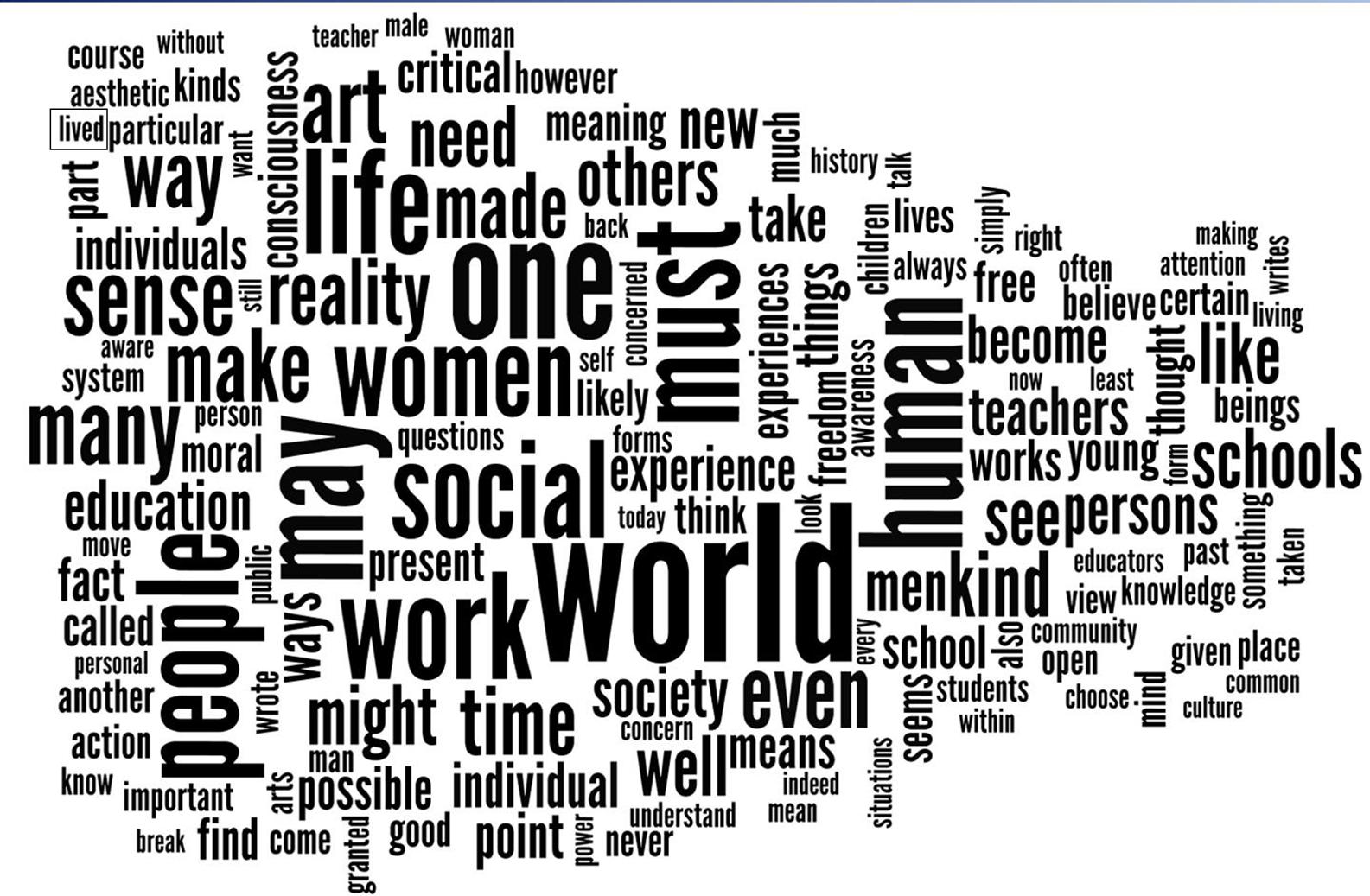
In contemplating how this dissertation that contemplates the use of "lived life" in Maxine Greene's writings could be visualized. I did some Wordle work with her texts.

I was interested in the visual because of my intention of using arts-based research in my work. I have thought of this dissertation as an exhibition of Greene's works, her art. And I felt it necessary to "see" the works in another medium.

But I love text. Yet, how can a textual-based exhibition be visual to the reader/attender? I go back to Barbara Kruger's work and Jenny Holzer's. Their pieces, so iconic for me of 1980s New York City, provide a kind of imprimatur of how text can be visual. What's more, the text itself can embody in an explicit way instead of a covert way, how images impact our own perspectives. I am reminded of this in reviewing Landscapes of Learning recently and thinking how Marshall McLuhan may have been a factor in Greene's discussion of Ellul's "encirclement". The idea that "people are experiencing themselves being worked on by forces as invisible as they are impersonal" (1978, p. 9).

And so I "Wordled" Greene's text. It's interesting to see the words that dominate. As I suspected, the "lived" in "lived life" is mostly prevalent in her later works (though it does reveal itself in Landscapes but not in the later Dialectic). Whether I use these images in my own textual copy is still unknown. But it was diversion, it provided another angle of repose in this crystallization of a reflexive practice.


Teacher As Stranger (1973)


Landscapes of Learning (1978)

 The Dialectic of Freedom (1988)


Releasing the Imagination (1995)


Variations on a Blue Guitar (2001)

Sunday, July 10, 2011

Greene-asserted and Greene-realized

My scanning thus far has actually only accounted for maybe a dozen, at most, instances of lived life/lives in Maxine Greene's writings. One of my earliest hunches in this inquiry was that the term only begins to become part of the Greene vernacular in her later writings. So far, this hunch is playing itself out.

I'm conceiving a series of turning points that each book seems to represent. My focus on Teacher as Stranger (1973), Landscapes of Learning (1978), The Dialectic of Freedom (1988), Releasing the Imagination (1995), and Variations on a Blue Guitar (2001) for this inquiry was borne out of an early notion that these books represent Greene's own voice. Her earlier works, Existential Encounters for Teachers (1965) and The Public School and the Private Vision (1968), struck me as primarily commentaries on other thinkers and writers. While Greene continues to cite and reference other writers and artists in the canon that starts in 1973, her own voice is pronounced in these later works. Perhaps one could perceive of this voice as a recitative; in effect, forwarding the ideas of these other writers and thinkers in a solo voice.
But the voice becomes stronger with subsequent works. Teacher as Stranger and Landscapes of Learning may indeed be a recitative of the works of Camus, Dewey, Kant, Kierkegaard, Melville, Merleau-Ponty, Sartre and others. But in her final section of Landscapes titled "Predicaments of Women," I sense a turning point in this coda to the book. Her chapter "Lived Worlds" is focused on the need for women to assert their own interpreted reality in a world that is largely reliant on a male perspective of reality.
My concern is for the release of individual capacities now suppressed, for the development of free and autonomous personalities. It seems to me that these require an intensified critical awareness of our relation to ourselves and to our culture, a clarified sense of our own realities (1978, p. 213).
It is a call to self-hood. As I conjectured in my 7/9 post, this "clarified sense of our own realities" is consciousness. This is a call to consciousness. The lived aspect of the lived world is consciousness. This final section of Landscapes represents, to me, a thrusting outward of Greene's push for social justice. It is Greene-assertive. It is the opening thrust of her voice.

Later, in Dialectic, the recitative is pianissimo. Greene comes back to the predicaments of women, calling  upon the unique, social, intertwined and situated realities of women as a just and valid point of view and source of knowledge:
A free act, after all, is a particularized one. It is undertaken from the standpoint of a particular, situated person trying to bring into existence something contingent on his/her hopes, expectations, and capacities. The world in which the person creates and works through a future project cannot but be a social world; and the nature of the project cannot but be affected by shared meanings and interpretations of existing social realities. John Dewey wrote, for example, that "while singular beings in their singularity think, want, and decide, what they think and strive for, the content of their beliefs and intentions is a subject matter provided by association” (1927/1954, p. 25).  If that association is conceived of as one among autonomous, rational beings who are convinced that reliable knowledge (being largely formal and rule-governed) does not vary among them, the very notion of singularity summons up a troubling relativism that makes suspect situated knowledge claims. This may partly explain, not only the lack of respect for women's thought processes on the part of men, but the efforts of certain women to suppress their own lived experiences in order to claim an equality in the domain of formal reason identified with the public sphere.
Dialectic represents a turning point, for me, of Greene-realized. My interpretation is finding the use of the qualifier lived in Greene's writing to be in direct correlation to an assertion of a distinct, political voice. In Markie Hancock's documentary, Exclusions and Awakenings (2001), Greene talks about the perils of of a Jewish woman finding a teaching job in higher education. She was told she was "too literary" which for her was code for "female." In Dialectic she writes about the struggle she experienced in how she pursued understanding:
From the beginning of my career, trying with some difficulty to be accepted as a philosopher of education, I found myself moving back and forth between imaginative literature and philosophy. Troubled by the kinds of positivism that identified existential questions (about birth and death and commitment and anxiety and freedom) with "pseudo-questions," with a domain of meaninglessness, I kept on stubbornly seeking out those questions in fictive and poetic worlds, in personal narratives. Troubled by impersonality, by abstract vantage points, I wanted people to name themselves and tell their stories when they made their statements. I came to believe (or I was taught) that "reality" referred, after all, to interpreted experience (1988, pp. xi-xii). 
 There might be a linkage between this practice of interpreted experience and the particularization/situatedness of women. It might be that the qualifier of lived is particular to the female experience. I'm not ready to affirm this as Dewey's influence in his accounting for experience is reflected in Greene's reading and writing. Yet experience, for Greene, takes into account the gaps/lacks/deficiencies that can only be recognized through reflection. The reflected life isn't always optimistic, and neither is Greene (Hancock, 2001). Wendy Kohli and others see this as a distinction between Greene and Dewey (Hancock, 2001). Greene's pessimism is situated to her own lived life as a woman in a man's world.

Sunday, July 3, 2011

On being within and without

I've been reviewing Maxine Greene's Landscapes of Learning. I was surprised to not see more instances of lived life/lives within the text, yet the term is present. What I think may be its variant, lived worlds, is especially prominent as it assumes the title of the final chapter of the book.

I am recognizing that within Landscapes, lived life is almost always connected to discussion regarding emancipation. This is an area that one of my committee members recommended I pay attention to when thinking about the lived life. And sure enough, there is a connection. Greene uses lived life within her discussion of emancipatory education, which signals the need for teachers to educate based on the lived lives of their students. This is supported through her sustained argument for the primacy of the students' lived lives over the benchmarks of empiricism and scientism, and our reliance on technique (a very interesting contrast perhaps to Stella Adler's adherence to technique?).

But the term, or its variant lived worlds, is also foundational to her discussion of the emancipation of women, especially women who teach. So the theme of emancipatory education is more than a focus on the students, but also on the teachers. Her discussion of the importance of recognizing the lived worlds of women is a charge for women to assert their own lived worlds, their own perceptual reality instead of donning a mask to assume another's sense of reality, another's sense of what everyday life is or should be. The power in asserting these lived worlds and lives is partly embedded in the power of giving symbol to these entities. Whether it be language or another form of expression (cue the arts here), giving a name to the perceived reality, to the lived life, is to give it form and to recognize it as substantial. It also provides the opportunity to then consider alternatives to a reality that may be full of lacks and deficiencies.

But how is the lived life achieved or assumed? To have a lived life one needs to be reflective Greene says. It is an act of consciousness.

In a sense, transcendences and interrogations provide a leitmotif in human experience as persons become increasingly able to thematlze, to problematize, to interpret their own lived worlds. Merleau-Ponty says that what defines the human being "is not the capacity to create a second nature--economic, social, or cultural--beyond biological nature; it is rather the capacity to go beyond created structures in order to create others." To me, this has enormous relevance for teaching--the kind of teaching that moves persons to reflection and to going beyond. Only, however, if educators can remain in touch with their own histories, their own background consciousnesses, can they engage with others who are making their own efforts to transcend (1978, p. 103).

So the lived life is an act of consciousness evoked by the individual. Right now I'm working with the idea that the lived life might also need to include the act of recognition by another for it to culminate. That the power of the lived life can only be achieved when one recognizes the value of another. It rests in the ability to of one to reflect/understand and the other to recognize.

On a side note: last night we saw a production of Smudge, a play by Rachel Axler. The story centers on a couple who give birth to a severely underdeveloped child; the baby is just a stub with a single eye, no limbs, no form of expression. The father works for the U.S. Census and starts reading  philosophical treatises on being-ness and consciousness while at work. His ponderings about the mass of grey that seems to now pervade his once black-and-white/binary/census-tract world erupts in a hysterical showdown between him and his brother/co-worker. I was laughing so hard the tears were streaming down my face. It was the perfect comic interlude for someone questioning "objectivity" in research.