Showing posts with label lived life. Show all posts

Saturday, October 8, 2011

Disappointment as validity

I have recently submitted a draft of my dissertation chapter devoted to "data collection and analysis." This is the chapter where my research question is answered--what does Maxine Greene mean when she uses lived life in her writing? And the answer was not what I had hoped for at the start of this process.

It had been my hunch--maybe even my desire--at the start of this journey that lived life in Maxine Greene's writing would designate the time and place in which the individual is fully conscious in the existential sense of coming to be as a result of reflective practice. I had thought and wanted lived life to be the already reflected life that poised the individual to consider alternative realities. But my analysis kept on questioning at what point consciousness/the consideration of alternative realities emerges within lived life. The analysis was showing me that consciousness was occurring after lived life had been established. In the end, lived life was somewhat analogous to the pre-reflective state of Husserl's life-world and Merleau-Ponty's primordial silence. Somewhat analogous.

My interpretive work revealed to me that though lived life occupies the realm of the pre-reflective state, it is distinct from the other sensibilities that name the state life-world or primordial silence. In the end, for me, lived life in Greene's writing is fully connected to the idea of personhood and the essence of being as tied to action. The lived life is distinct to Greene's philosophy.

I stumbled though with trying to comprehend just what the pre-reflective state is in an existential consciousness. I eventually was able to conceptualize physically through a gesture/physical state that is linked to the moment prior to going on stage, to singing a song, to applying paint to a canvas. For me, it is the body lifted out of its gravitational pull into the hips (for women). In this place, the body can go anywhere: forward, backward, upward or downward. It's the moment before the choice of movement or direction has been decided or communicated to the brain.

It was interesting in talking about this process and discovery this week with a colleague at work. When I described to her my difficulty in comprehending the pre-reflective, she stated easily and eagerly "well, that's what most of life is and how we operate--in the pre-reflective." It was then that I realized that I have been living in a hyper-activated state for a few years now. The dissertation has me thinking and reflecting at every moment of repose (my morning showers are especially reflective). My new job has me analyzing and assessing the best course of action with everything I do. Even house chores have me thinking about the most time-efficient way of feeding the cat while thawing the turkey sausages and gathering the recycling for pick up the next morning.

I titled this post "Disappointment as validity." The idea of triangulation with hermeneutical work can be challenging. The researcher has to be cautious in regards to confirmation bias--not allowing the interpretation to play out as I would want it to. And so now that lived life isn't what I had thought and really, wanted it to be, I feel that I have brought a valid viewpoint to bear on my answer. And so my disappointment is my validity.

Sunday, August 21, 2011

Choice in lived life

This weekend has been devoted to some final notes on Maxine Greene's use of lived life in Variations on a Blue Guitar. The book is a series of lectures that Greene has given over the years at the Lincoln Center Institute where she is philosopher-in-residence. It is fitting that the writings/lectures are focused on aesthetics and teaching as the Institute is devoted to a particular kind of arts education developed under her guidance and the target population is K-12 teachers.
I think I may be finding a different sensibility regarding the lived life in these lectures/writing but more on that in a later post.

In reviewing this anthology, I was reminded this weekend of the tenet I held as an actor living and working in New York City in the 1980s and '90s. The tenet--or perhaps, justification--was the importance I placed in having a job outside of acting. It was necessary to be working in any capacity in order to pay the rent but it was also necessary to be working consistently in an institution so that I could get health insurance. I also held that it was important to work outside of acting in order to have experiences with the "real world" and with "real people" from which to draw inspiration for my acting. But then again, maybe it was just a ruse to excuse myself from not working harder at becoming a commercially successful actor.

No matter the reasons, I worked. And I worked for about eleven years as the supervisor of the TKTS booths in New York where you could buy a discounted ticket to a Broadway or off-Broadway show on the day of the performance.
It was spring of 1987. I was rehearsing a production of Strindberg's The Ghost Sonata, directed by Travis Preston (now of CalArts). It was a huge, wild production. I played the Fiancee, a mute part that was on stage for more than half of the play. The Fiancee is essentially waiting, for decades, for her betrothed to marry her. She is only seen and never heard.

With this, the physicality is paramount and I was working on developing a movement life for the Fiancee. Early one matinee Wednesday morning as I was readying Duffy Square for the matinee onslaught of Long Island/New Jersey/Connecticut/Upstate ladies who lunch, I couldn't help but to stare at a woman--who many years later I determined was trans--making her way down 7th Ave.
She was tall, gaunt, with a full face of makeup that looked like it was left over from the night before. She wore a lime-green polyester pant suit and high-heeled strappy sandals. She was smoking a cigarette in slow motion. She moved down the street without looking at where she was stepping. She was slightly unsteady, the look of a drunk trying not to look drunk. She was trying to avoid the piles of horse manure that littered the street (NYPD often used mounted police in that area) and was mostly successful but would occasionally catch the edge of a clump in her strappy sandals resulting in a near stumble.

It was the Fiancee. I had found my muse.

Though my body type was quite different from this lime-green vision, her walk and carriage became the body for the Fiancee. Her slow motion smoking became my focus of an act-long party scene that was seated around a six-foot slab of ice that slowly melted under the stage lights.

I come back to all of this because my assumption in thinking about the lived life within the aesthetic experience led me to conceive of my lime-green muse as part of my lived life as an actor. Those movements and people who serve as inspiration are the lived life I am exploring in Greene's work.
But after reviewing Variations, I'm shifting. I think it is the act of choosing I took in focusing on that woman making her way down 7th Ave. in spring 1987 that is the lived life. The lived life is how I go about making those choices, not the actual choice itself. What isn't clear to me, yet, is whether the recognition of those choices is considered part of the lived life or if lived life is the platform on which recognition and reflection can occur but only through follow-through; that reflection may not be a guaranteed element of lived life. In Variations, lived life is always presented as the "background" against which viewers/attenders/teachers/students can encounter a work of art. It is through these encounters with works of art that alternate realities can be considered and ultimately, lived lives can be transformed.

Lived life is certainly nuanced.

Wednesday, August 17, 2011

Textual imagery

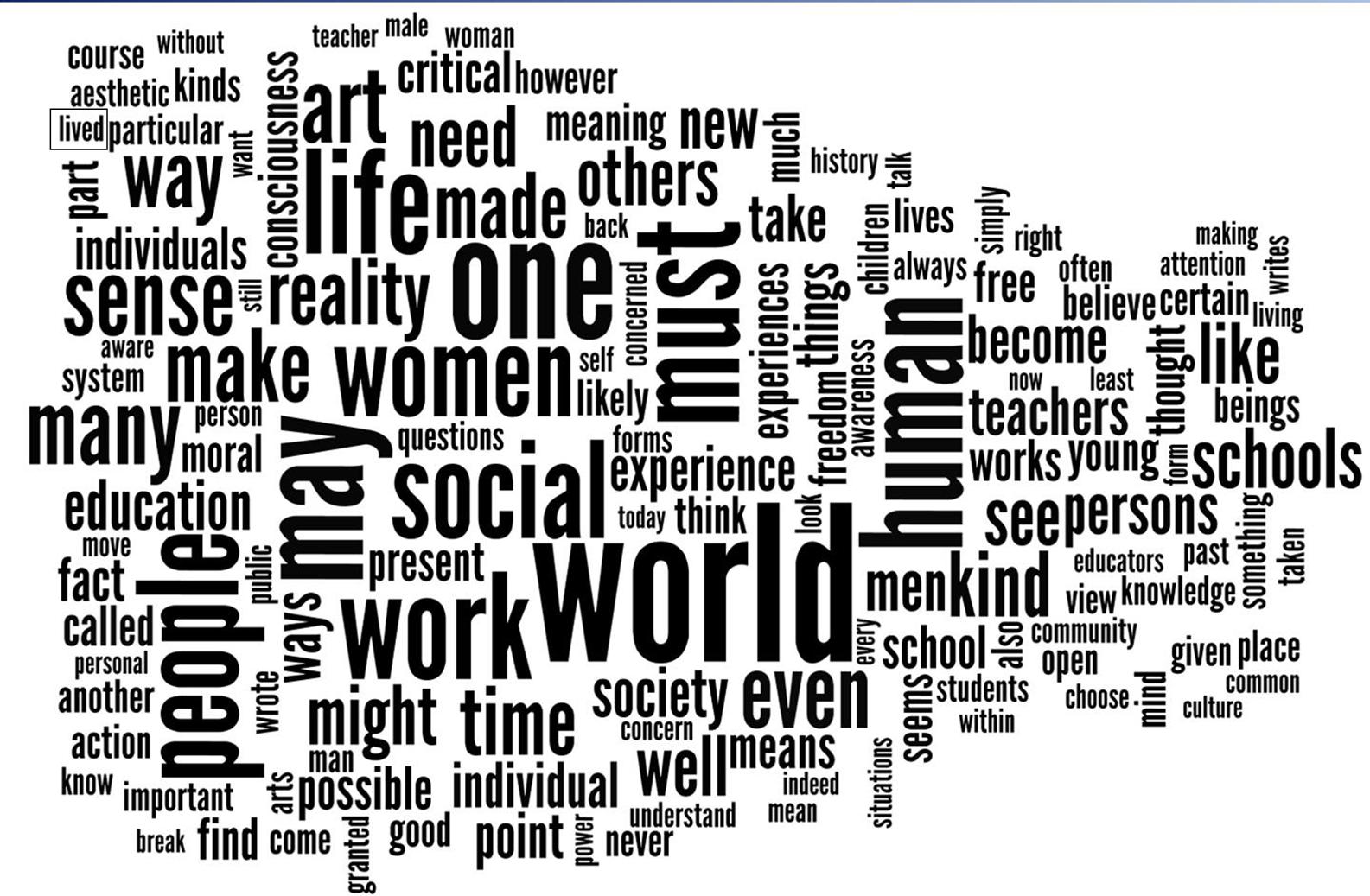
In contemplating how this dissertation that contemplates the use of "lived life" in Maxine Greene's writings could be visualized. I did some Wordle work with her texts.

I was interested in the visual because of my intention of using arts-based research in my work. I have thought of this dissertation as an exhibition of Greene's works, her art. And I felt it necessary to "see" the works in another medium.

But I love text. Yet, how can a textual-based exhibition be visual to the reader/attender? I go back to Barbara Kruger's work and Jenny Holzer's. Their pieces, so iconic for me of 1980s New York City, provide a kind of imprimatur of how text can be visual. What's more, the text itself can embody in an explicit way instead of a covert way, how images impact our own perspectives. I am reminded of this in reviewing Landscapes of Learning recently and thinking how Marshall McLuhan may have been a factor in Greene's discussion of Ellul's "encirclement". The idea that "people are experiencing themselves being worked on by forces as invisible as they are impersonal" (1978, p. 9).

And so I "Wordled" Greene's text. It's interesting to see the words that dominate. As I suspected, the "lived" in "lived life" is mostly prevalent in her later works (though it does reveal itself in Landscapes but not in the later Dialectic). Whether I use these images in my own textual copy is still unknown. But it was diversion, it provided another angle of repose in this crystallization of a reflexive practice.


Teacher As Stranger (1973)


Landscapes of Learning (1978)

 The Dialectic of Freedom (1988)


Releasing the Imagination (1995)


Variations on a Blue Guitar (2001)

Saturday, August 6, 2011

From transaction to transformation


One of my committee members recently commented on my embodiment post. In my response I started to focus on the idea of transaction. The focus arose out of a desire to promote and enhance the concept of the quality of transaction in Greene's writing. It occurred to me that the way in which we interact with the world deepens this sense of embodiment and differentiates Greene from other thinkers and writers who have commented on embodiment.

I noted that embodiment is about the constant reflection of how we view ourselves within the context of our perceived world. It is my sensibility that we are witness to transactions with the world that continue to operate within the realm of a mind/body split. I am thinking in terms of educational practice and in how we define success. We continue to assess the success of our students (and our practice) through a predominately retention/regurgitation framework. And though I'm critiquing policy with this example, policy is a means of how we transact with the world. 

Of course, this can all be viewed as a transactional dilemma: our misguided practices are fundamentally poorly conceived transactions with the world. However, does how we transact connect directly to something more profound than mere practice options? Is this why we struggle with social justice? Is this why social justice isn't just the soil (per Dewey's discussion of embodiment in Nature and Experience) but points to a more profound split? How do the bottom-line-must-dominate CEOs and the just-say-no legislative representatives and their practices sleep at night? I conceive of these practices as poor transactions. I conceive of these transactions as a fundamental split between mind and body. With that split, the transactional can never become transformational.

With Greene, I can start to chart a process by which the transactional becomes transformational. In transacting with the world, we become situated in our understandings, our processes, our angle of repose. Through reflection this situatedness becomes embodied. Our understanding signifies that union of mind and body, even relinking what once may have been split. This is what represents the lived life: the embodied situatedness of our being. It is the lived life that primes us to encounter the world through an aesthetic experience. The aesthetic represents the embodied encounter, an encounter that has the ability to be transformative because of the reflective practice that enables us to notice the new. It is the act of writing and rewriting our lived world (Releasing the Imagination, 1995, p. 147).

Sunday, July 24, 2011

The sediment of embodiment

In using this blog I have come to realize that there are stirrings and strains within my thinking that keep on re-emerging time and time again. When I review past postings, I see my hunches and notions playing out at different periods during this process, often without memory of their previous existence. For instance, claiming the use of my first-person voice as a creative act. When I wrote about that notion within my methodology chapter, I hadn't realized I had considered it months earlier in Living [Maxine] Greene.

This past week I discovered that my interest in embodiment as a function of learning, as a function of coming to know, as a function of consciousness, has been stirring within for some time. During the week I was teaching a one-week intensive in arts education for masters-level students. One of our sessions included a visit from a teaching artist who presented work she had done in a residency at a school of one of my former students.

The impetus for the residency arose out of my student's frustration as a math interventionist. The interventions she was assigned to use consisted of worksheets: paper and pencil.  But the students she was assisting did not excel in paper and pencil approaches. We tossed around ideas about arts integration strategies that she might attempt in the seated-at-desks setting that she and her students occupied. But what became apparent was the kinesthetic tendencies these students had towards their learning. "Get thee to a movement specialist," I advised her, "and let the embodiment of math begin!"

The residency came together and the movement specialist took my recent class through some of the work she did with the students. But the discussions and ruminations I had with the math interventionist occurred long before my literature review where embodiment presented itself to me as a foundation for coming to know the lived life. Clearly, embodiment was been part of the "sediment" I bring to my inquiry. This sediment is not fixed according to Greene:
And we need, as Maurice Merleau-Ponty has put it, to form the events we uncover in the past into an "intelligible series," the events that sediment meanings in us, "not just as survivals or residues, but as the invitation to a series, the necessity of a future" (LL, 1978, p. 119).
Sediment indicates a layering and accumulation of meaning which allows for change over time. The fossils infused in the first strata, while foundational in character, don't prescribe a sameness within the subsequent accumulating layers.

In writing this post I am also connecting back to my own training as an artist which, at one point, was rigorously physical in its approach. My work with Anne Bogart, Kevin Kuhlke, Nina Martin, Wendall Beavers, Mary Overlie, Paul Langland, Torben Bjelke, Maria Consagra and others focused on the idea of physical improvisation to find and sustain character development. Though I did note this in my dissertation, somewhere, I tend to forget this most obvious element in my focus on embodiment. It's what a former roommate would call a "no duh" moment (he's now a full professor of philosophy in the Midwest so I embrace his neologisms with hope).

And so this sediment of embodiment is present within me. It is foundational in how I have come to engage in the arts and in the world. It aligns with the sense of accumulation, where meaning and interpretation can change over time. It is most certainly Merleau-Ponty's "invitation to a series, the necessity of a future" (Themes from the Lectures at the College de France 1952-1960, Evanston: Northwestern University Press, 1970, pp. 40-41). It is also the basis of the aesthetic experience of learning. These connections give me pause, compel me to reflect, find me forgetting to breathe and often on the edge of my seat.

Saturday, July 9, 2011

The "lived" as emergent

I am looking at Maxine Greene's The Dialectic of Freedom (1988). I remember the first time I read it was on the Amtrak platform in Hartford, CT waiting for the train back to Grand Central. I had misread the train schedule and found myself with a couple of hours to kill before boarding. So I opened up Dialectic. I was in grad school, studying with Greene, and thought it a good idea to read some of her works. I picked up an idea or two from the book but for the most part, I couldn't make a connection. I just wasn't "there" yet; "there" being situated for discussion about how freedom and new possibilities are created through consciousness and reflection.
I think I'm approaching "there" now.

In looking at Dialectic, I am finding a clearer sensibility, for myself, about what goes into creating a lived life, a lived world, a lived situation, a lived experience. It is an active, reflective process that is foundational to consciousness. I had come to this understanding the connection of reflection with consciousness in my reading of Merleau-Ponty and Sartre and certainly Dewey, who distinguishes consciousness as “the continuous readjustment of self and the world in experience” (Art as Experience, 1934, p. 270). Greene notes in Dialectic,
There is a difference between those who unquestioningly accede to the given and those who find refuge in that way. In both cases, however, there is an incapacity to look at actualities as if they could be otherwise, as there is an unwillingness to try to transcend determinacy or surpass facticity. Consciousness, it so happens, involves the capacity to pose questions to the world, to reflect on what is presented in experience. It is not to be understood as an interiority. Embodied, thrusting into the lived and perceived, it opens out to the common. Human consciousness, moreover, is always situated; and the situated person, inevitably engaged with others, reaches out and grasps the phenomena surrounding him/her from a particular vantage point and against a particular background consciousness (1988, p. 20).
From this I take "lived" as a qualifier that is only achieved through the act of consciousness. What's more, Greene makes it clear that consciousness is not an internal mechanism, but an outward one. This presents for me an interesting contrast to Stella Adler and "Hamlet was not written about your mother." The lived life, though it necessitates an inward process of reflection, it is only achieved through the active pursuit of engaging with the "common" or the world in which we're situated. Where Adler may have rightfully been concerned about an actor turning inward in their craft making engagement with the audience difficult, the reflected life requires the actor to turn outward, to consider their experiences in contrast to that of others.

This also aligns with the active idea of doing philosophy or doing history. It aligns with learning as an active process, not a situation with the student as vessel to be filled by the accepted, rule-formed world of reliable knowledge. For Greene the lived life is an emergent entity that is always changing as the indiviudal changes. It is not static. And neither is learning. It is never complete. It needs to always be emergent.

The "lived" as active

I am looking at Maxine Greene's The Dialectic of Freedom (1988). I remember the first time I read it was on the Amtrak platform in Hartford, CT waiting for the train back to Grand Central. I had misread the train schedule and found myself with a couple of hours to kill before boarding. So I opened up Dialectic. I was in grad school, studying with Greene, and thought it a good idea to read some of her works. I picked up an idea or two from the book but for the most part, I couldn't make a connection. I just wasn't "there" yet; "there" being situated for discussion about how freedom and new possibilities are created through consciousness and reflection.

I think I'm approaching "there" now.

In looking at Dialectic, I am finding a clearer sensibility, for myself, about what goes into creating a lived life, a lived world, a lived situation, a lived experience. It is an active, reflective process that is foundational to consciousness. I had come to this understanding the connection of reflection with consciousness in my reading of Merleau-Ponty and Sartre and certainly Dewey, who distinguishes consciousness as “the continuous readjustment of self and the world in experience” (Art as Experience, 1934, p. 270). Greene notes in Dialectic,
There is a difference between those who unquestioningly accede to the given and those who find refuge in that way. In both cases, however, there is an incapacity to look at actualities as if they could be otherwise, as there is an unwillingness to try to transcend determinacy or surpass facticity. Consciousness, it so happens, involves the capacity to pose questions to the world, to reflect on what is presented in experience. It is not to be understood as an interiority. Embodied, thrusting into the lived and perceived, it opens out to the common. Human consciousness, moreover, is always situated; and the situated person, inevitably engaged with others, reaches out and grasps the phenomena surrounding him/her from a particular vantage point and against a particular background consciousness (1988, p. 20).
From this I take "lived" as a qualifier that is only achieved through the act of consciousness. What's more, Greene makes it clear that consciousness is not an internal mechanism, but an outward one. This presents for me an interesting contrast to Stella Adler and "Hamlet was not written about your mother." The lived life, though it necessitates an inward process of reflection, it is only achieved through the active pursuit of engaging with the "common" or the world in which we're situated. Where Adler may have rightfully been concerned about an actor turning inward in their craft making engagement with the audience difficult, the reflected life requires the actor to turn outward, to consider their experiences in contrast to others.


Sunday, July 3, 2011

On being within and without

I've been reviewing Maxine Greene's Landscapes of Learning. I was surprised to not see more instances of lived life/lives within the text, yet the term is present. What I think may be its variant, lived worlds, is especially prominent as it assumes the title of the final chapter of the book.

I am recognizing that within Landscapes, lived life is almost always connected to discussion regarding emancipation. This is an area that one of my committee members recommended I pay attention to when thinking about the lived life. And sure enough, there is a connection. Greene uses lived life within her discussion of emancipatory education, which signals the need for teachers to educate based on the lived lives of their students. This is supported through her sustained argument for the primacy of the students' lived lives over the benchmarks of empiricism and scientism, and our reliance on technique (a very interesting contrast perhaps to Stella Adler's adherence to technique?).

But the term, or its variant lived worlds, is also foundational to her discussion of the emancipation of women, especially women who teach. So the theme of emancipatory education is more than a focus on the students, but also on the teachers. Her discussion of the importance of recognizing the lived worlds of women is a charge for women to assert their own lived worlds, their own perceptual reality instead of donning a mask to assume another's sense of reality, another's sense of what everyday life is or should be. The power in asserting these lived worlds and lives is partly embedded in the power of giving symbol to these entities. Whether it be language or another form of expression (cue the arts here), giving a name to the perceived reality, to the lived life, is to give it form and to recognize it as substantial. It also provides the opportunity to then consider alternatives to a reality that may be full of lacks and deficiencies.

But how is the lived life achieved or assumed? To have a lived life one needs to be reflective Greene says. It is an act of consciousness.

In a sense, transcendences and interrogations provide a leitmotif in human experience as persons become increasingly able to thematlze, to problematize, to interpret their own lived worlds. Merleau-Ponty says that what defines the human being "is not the capacity to create a second nature--economic, social, or cultural--beyond biological nature; it is rather the capacity to go beyond created structures in order to create others." To me, this has enormous relevance for teaching--the kind of teaching that moves persons to reflection and to going beyond. Only, however, if educators can remain in touch with their own histories, their own background consciousnesses, can they engage with others who are making their own efforts to transcend (1978, p. 103).

So the lived life is an act of consciousness evoked by the individual. Right now I'm working with the idea that the lived life might also need to include the act of recognition by another for it to culminate. That the power of the lived life can only be achieved when one recognizes the value of another. It rests in the ability to of one to reflect/understand and the other to recognize.

On a side note: last night we saw a production of Smudge, a play by Rachel Axler. The story centers on a couple who give birth to a severely underdeveloped child; the baby is just a stub with a single eye, no limbs, no form of expression. The father works for the U.S. Census and starts reading  philosophical treatises on being-ness and consciousness while at work. His ponderings about the mass of grey that seems to now pervade his once black-and-white/binary/census-tract world erupts in a hysterical showdown between him and his brother/co-worker. I was laughing so hard the tears were streaming down my face. It was the perfect comic interlude for someone questioning "objectivity" in research.

Saturday, June 25, 2011

A conversation with the text

In my earlier post today I mentioned that I scanned Maxine Greene's Teacher as Stranger (1973) to locate instances of lived life in the text. There were none.

This was a hunch that I had prior to the data collection and knowing that, I made sure to also scan for what I might interpret as variations on lived life. And sure enough I was able to locate life-world which originated with Edmund Husserl. I also have a hunch that life-world becomes less frequent in Greene's later writings when lived life starts to make a presence. This may be a situation of coincidence, but it is possible that Greene abandoned Husserl's "Umwelt" for lived life.

With the scanning, I found myself talking to the text. Because lived life wasn't presenting itself, I started to take notice of other qualified "lifes" in Greene's writing: social life, family life, instinctual life, to name a few. I asked aloud if I would find these "lifes" in her later books. If I was to find that they're not present in her later books, would it be a fair deduction for me to think of these other "lifes" as being subsumed by lived life? Could lived life be a repository for the social, family, and instinctual aspects of life? If lived life is such a repository, could this mean that what once might have stood as a clear distinction among these other qualified "lifes" becomes blurred in Greene's later writing and thinking? Are these qualified "lifes" too intersubjectve/interconnected to be distinguished from one another?

I might be in line for a hermeneutic hat trick here...

Hamlet was not written about your mother

The title of this blog post is the subtitle for my dissertation rationale. "Hamlet was not written about your mother" refers to a adage that I remember from my days as an acting student at the Stella Adler Conservatory.

My interpretation of this adage was the Adler idea that the actor should not bring their own emotional background into the creative process of developing a character. A character was to be created solely from the circumstances provided by the playwright. No matter how much my adolescent sensibility might ascribe Gertrude-like qualities to my own mother, the fact was simple: Shakespeare did not write Hamlet about Maureen Dotsch Powers.

I recently presented this rationale to my dissertation committee during my proposal defense. They accepted it. They also suggested that I spend more time looking at artists and philosophers who share in the Adler focus of creativity that is divorced from the artist's background, emotions, experience--their lived life.

I spent time yesterday scanning Greene's Teacher as Stranger (1973) for instances of lived life and other possible variations on its theme. I came across her chapter, "Truth and Belief" where Greene uses Hamlet to differentiate between the perspectives of the pragmatist and the phenomenologist. She begins this discussion by identifying the situatedness of Hamlet:
He nevertheless perceives the court from a distinctive point of view. After all, he is the son of the dead king; he was in line to inherit the throne. His peculiar biography is bound to make his interpretations somewhat different from Horatio's, say, or Laertes', or even Claudius's. These men all belong to the same cultural matrix; they participate, without much thought, in the same ceremonies. But having had different subjective experiences, each of them is in a distinctive situation and bound to interpret novel events in his particular fashion. What each one comes to "know," therefore, will have much to do with the way he locates himself and with the relevance of what is happening to his own concerns (1973, p. 133).

With this focus on situatedness we can assume that Hamlet's sense of "mother" is likely to be different than Laertes', and Laerties' is likely to be different from his sister's Ophelia's. Greene makes her case that the phenomenologist never takes a passive approach to making sense of their world; nothing is taken for granted. For the phenomenologist,
Not only is the observer's subjectivity involved; so are the subjectivities of his contemporaries, and the intersubjective reality they mutually create...intersections, zones, and horizons are significant in the knowing process (1973, p. 134).

Greene's use of "observer" here immediately brings to my mind "audience" with her use of a theatrical artwork as her reference. Replacing "observer" with "audience" and I think about the viewer's experience of a production of Hamlet. The audience is likely to bring with them their own situatedness in attending to the performance. They are likely to forge "intersections, zones and horizons" between their prior experience and the production they are viewing. And here I come across an interesting question: did Stella Adler expect the audience to bring their own subjectivities, their own situatedness, in coming to know and understand Hamlet? Or was their understanding only begotten by what the actors provided?

Because I have been studying and practicing Greene's approach to aesthetic education and inquiry for so long, I have to work hard to de-couple myself from her sensibility. As such, my immediate response to this question is that Adler would have had to expect the audience to come to the theatre with their own subjectivities. Yet, if I pause, I can also understand how Adler might have chafed at an audience that allowed their subjectivities to influence their understanding. Just as she urged actors to "be in the moment" I can imagine that she would have advocated the same of an audience. That moment is comprised of the world of the play, not the traffic encountered on the way to the theatre or the long line outside the women's restroom in the lobby.

But can we really expect such isolation of experience? Again, I am hugely influenced by my own background and horizons that understand experience to be part of a continuum. As a member of that group of believers, I cannot fathom experience not colored by subjectivity.

Or for that matter, research that is purely objective.

Sunday, May 1, 2011

Knocking on the text

I have been trying to get my head around the methodology I will be using in my dissertation. I have been reading and researching for months now. I've been through books and too many articles on arts-based educational research; I had a foray into ethnography; I spent a lot of time contemplating reflexive methodologies (how reflexive of me!); and now, hermeneutics. At some point, this research has got to conclude. It must come to an end.

I think I know where I'm headed. I believe that what I'm doing with Greene's texts is, at the first level, a curatorial process that Graeme Sullivan mentions in Art Practice as Research (2010). Like a curator, I'm attempting a new perspective on her works of art/texts. The curatorial practice should start from a place of resonance and wonder (Stephen Greenblatt in Exhibiting Cultures, 1991) for the curator/dissertation writer in regarding these works that hopefully inspires the same in the viewer/reader. Within the hermeneutic tradition promoted by Alvesson and Skoldberg in Reflexive Methodology (2000), this resonance and wonder represents what they call "primary interpretation" (p. 261). This is a recognition that "interpretation precedes data in all research" (p. 261). My choice of pursuing the idea of the "lived life" in Greene's writings is my primary interpretation. The "lived life" presents a sense of resonance for me and wonder that triggers my inquiry.

Alvesson and Skoldberg recommend a thorough practice of reflexive methodology where the inquiry undergoes four levels of interpretation. This is to ensure validity of the research product  and, I think, validity of the practice within the research field. There is not enough time for me to enter into these four levels: interaction with empirical material; interpretation; critical interpretation; and reflection on text production and language use. I think I will only get as far interpretation, or second-level reflexivity. The secondary interpretation I have been envisioning is a discursive inquiry into the text that resembles a "horizontal fusion between researcher and text" (Alvesson and Skoldberg, 2000, p. 264). This fusion is how the authors view the existential hermeneutics of Heidegger and Gadamer.

Yet what precedes all of this is a discussion of the postmodern, poststructural viewpoint of the relationship between subject and object. It's an understanding that reality is always subjective and by extension, there is no such thing as pure objectivity. This is why I view it to be disingenuous to limit the narrative voice in research to a distant third-person viewpoint. The researcher is always present.

Another facet of this reflexive practice is the use of writing as inquiry. Writing as a way of coming to know and a way of becoming, as in this blog. This is what Laurel Richardson (2005) refers to as "creative analytical processes" or CAP.

In the end, my dissertation is only a slight digging below the hermeneutical surface of the "lived life" in Greene's texts. To achieve the exhaustive four levels of interpretation of Alvesson and Skoldberg is to enter the domain of post-doctoral work. Nevertheless, I am excited about this fusion of practices. What has become very apparent to me in this arduous journey is how the "lived life" is playing through the methodology. These reflexive methods all take the situatedness of the researcher into consideration through honoring the researcher's lived life in its impact on the research.

Thursday, March 17, 2011

Reconciliation and disembodiment

I'm trying to reconcile some of what I teach with some of what I have written.

The other day I showed my students a favorite TED talk. It is with the writer Elizabeth Gilbert who speaks with eloquence, ease, humor, and self-deprecation about our post-Renaissance ideas regarding genius. Remarking on the recent--as in post-Renaissance--history of artists who are considered geniuses and their tendency to die at their own hands (or bottles), Gilbert advocates for thinking of genius, and creativity, as something that is sourced outside of our beings. It is the ancient Greek and ancient Roman framework of having genius, a person who is visited upon with genius, as opposed to being a genius. She sees this framework as addressing the need to provide distance between the work and the artist in the interest of preservation.

Gilbert uses a wonderful example of this visiting genius in her description of an
Encounter recently where I met the extraordinary American poet Ruth Stone, who's now in her 90s, but she's been a poet her entire life and she told me that when she was growing up in rural Virginia, she would be out working in the fields, and she said she would feel and hear a poem coming at her from over the landscape. And she said it was like a thunderous train of air. And it would come barreling down at her over the landscape. And she felt it coming, because it would shake the earth under her feet. She knew that she had only one thing to do at that point, and that was to, in her words, "run like hell." And she would run like hell to the house and she would be getting chased by this poem, and the whole deal was that she had to get to a piece of paper and a pencil fast enough so that when it thundered through her, she could collect it and grab it on the page. And other times she wouldn't be fast enough, so she'd be running and running and running, and she wouldn't get to the house and the poem would barrel through her and she would miss it and she said it would continue on across the landscape, looking, as she put it "for another poet." And then there were these times -- this is the piece I never forgot -- she said that there were moments where she would almost miss it, right? So, she's running to the house and she's looking for the paper and the poem passes through her, and she grabs a pencil just as it's going through her, and then she said, it was like she would reach out with her other hand and she would catch it. She would catch the poem by its tail, and she would pull it backwards into her body as she was transcribing on the page. And in these instances, the poem would come up on the page perfect and intact but backwards, from the last word to the first.
It is a marvelous image of inspiration as a "thunderous train of air" barreling down the landscape.

My students and I have been looking at the definitions of creativity and transformation over the last few weeks. Gilbert's talk about the source of creativity and the need to disembody oneself from it follows a similar framework used in the communication and self-help fields (Eckhardt Tolle and the other PBS-pledge-drive ilk). It is a framework that differentiates between being and having. For instance, effective communication can happen when the parties move the sense of being angry to a sense of having anger.

I understand this perceived need for preservation and the drive to create distance between the inspiration and the self. I did it myself when I left acting. But at that moment of inspiration, the genius is embodied. Stone is possessed by it when she races to a paper and pencil. It is the creative act as aesthetic experience. While artists may be made vulnerable in their inability to distance their selves from their work, I think that for others another vulnerability may take hold in the form of Dewey's anaesthetic. In the form of the unlived life.

Of course, the sense of being a genius as opposed to a sense of having genius is a linguistic trick as well. We are how we express our ideas in language. We can preserve our creative livelihood through language while denying ourselves the unlived life.

Tuesday, December 28, 2010

The lived-through versus the lived life

I am scouring Merleau-Ponty's "Phenomenology of Perception" in an attempt to understand Maxine Greene's development of the "lived life." Though I haven't come across the "l-l" paradigm, I have used the occasion to try to find the origins of le corps vecu or, "the lived body," as mentioned in Baldacchino. After running around in circles, I have come across discussions in papers posted on the Internet about Merleau-Ponty and Husserl and their views on "le corps vecu" or in the case of Husserl, "Leib." I will now take a look at Husserl to try to come to terms with "Leib." (Thank goodness for holiday gift cards redeemable at book retailers.)

In my quest for "le corps vecu" in Merleau-Ponty, I came across instances of the "lived-through." In closing the mind/body split, Merleau-Ponty proposes that it is a synthesized and unified body that grasps meaning and that the body is a "grouping of lived-through meanings."

Later in the book, the "lived-through" takes on qualifiers such as "purely" and "merely." Merleau-Ponty makes it clear that the lived-through in and of itself is not an experience without the possibility of expression: "Moreover, there is no experience without speech as the purely lived-through has no part in the discursive life of man."    

So now I ask, is the "lived life" in Maxine Greene a more fully realized concept of experience than the merely "lived-through"? Is the "lived life" a fuller embodiment that takes into account expression? Time will tell...

Sunday, August 15, 2010

Text is cool. Language is hot.

The scanning process continues. I try to be cool and objective, literally searching--without digital or electronic aid-- for the term "lived life." But then I get swept into the language. I try not to see the "language," but instead to search for text. Just words. A couple of "l's" strung together. It's a "Where's Waldo?" approach.

But Greene sweeps me in with her language. I end up reading and thinking and interpreting and bringing my particular sense, my live life, to the language.

This happened with Greene's chapter on "Approaches to Truth and Being" in "Teacher as Stranger." In her remarks about pragmatism, phenomenology, and existentialism,, I started to see Greene's foundation in her doing philosophy. I see her disposal of the role of pragmatism in its attempts to measure things, like humans, that cannot possibly be measure without some accounting of biography. While "lived life" isn't being used, I think I'm witnessing its development here in this 1973 publication.

Earlier this morning I reviewed a booklet on dissertations in the humanities. One of my committee members very thoughtfully sent it to me to help me with this framework. It's quite different form the empirical/science-based framework that is being promoted within the Ed.D. program. The booklet offers standards that use descriptors of outstanding, very good, acceptable and unacceptable.

Within one of the standards for outstanding, the qualities listed int he area of language included "hot." I like this. Language should be hot.

Text, on the other hand, is cool.

Friday, August 13, 2010

Panic & Spiraling

I was scanning "Teacher as Stranger" yesterday looking for the term "lived life" in Greene's text. I'm up to chapter 5 and haven't come across it. Oh dear. And the Amazon "search inside" feature of "The Dialectic of Freedom" also didn't find any occurrences of the term. Yikes.

My concern/panic/hive-inducing-dilemma is that I had thought the term appeared in these texts. My research methodology (I call it "practice") also assumes this.

But I did come across the term "life-world" in "Teacher as Stranger." It's a term I don't recall hearing or reading before in Greene's works. Maybe "life-world" developed into "lived life" in Greene's later texts? Another reason may be that Greene's later texts ("Releasing" and "Variations") are more closely aligned with aesthetic practice. So perhaps "lived life" is rooted in Greene's aesthetic philosophy?

And if so, can I still find a bridge between Greene's use of "lived life" and her focus on social justice? Or is "lived life" distinctly and discretely contained in aesthetics without a bridge into social justice? I hope not. Nor can I imagine such discrete applications in Greene's thinking and writing.

I had a conversation yesterday with a student. She's a distance learner in my Critical Perspectives course. We were talking about Dewey's definition of the aesthetic experience as having a conclusion or end. Yet aesthetic practice sees instead a spiraling that occurs. There is no end to the aesthetic experience. Questions beget questions. Inquiry branches into inquiry. There is a spiraling that occurs where the circulating movement of questions and inquiry expands wider and wider.

I'm spiraling.

Wednesday, August 11, 2010

Hello and welcome

I am starting this blog, "Living [Maxine] Greene,"  as part of my dissertation writing process. As made evident form the title, my dissertation focuses on Maxine Greene, the "philosopher queen" of Teachers College. It is my intention to define what Maxine means by the term the "lived life" in her writing and speaking. It's a term that has stuck itself into the far corners of my consciousness since I first studied with her in 1994.

I am using a pseudo arts-based educational research practice for my dissertation work. It is interpretive in nature and a means towards establishing my interpretations validity is through a process of self-reflection. And self-reflection is very appropriate in all things Maxine. The arts piece will be reflected in the use of my narrative "I" in my dissertation writing (also appropriate to Greene) which is not typical of the academy. It is also likely that some of these blog posts will not only inform my interpretation but they may even appear in the final product.

Big props must be extended to Cynthia Vascak of PSU for her coining of "Living Greene." Thanks, Cynthia.

And so here we go, here I go. Thank you, Maxine.