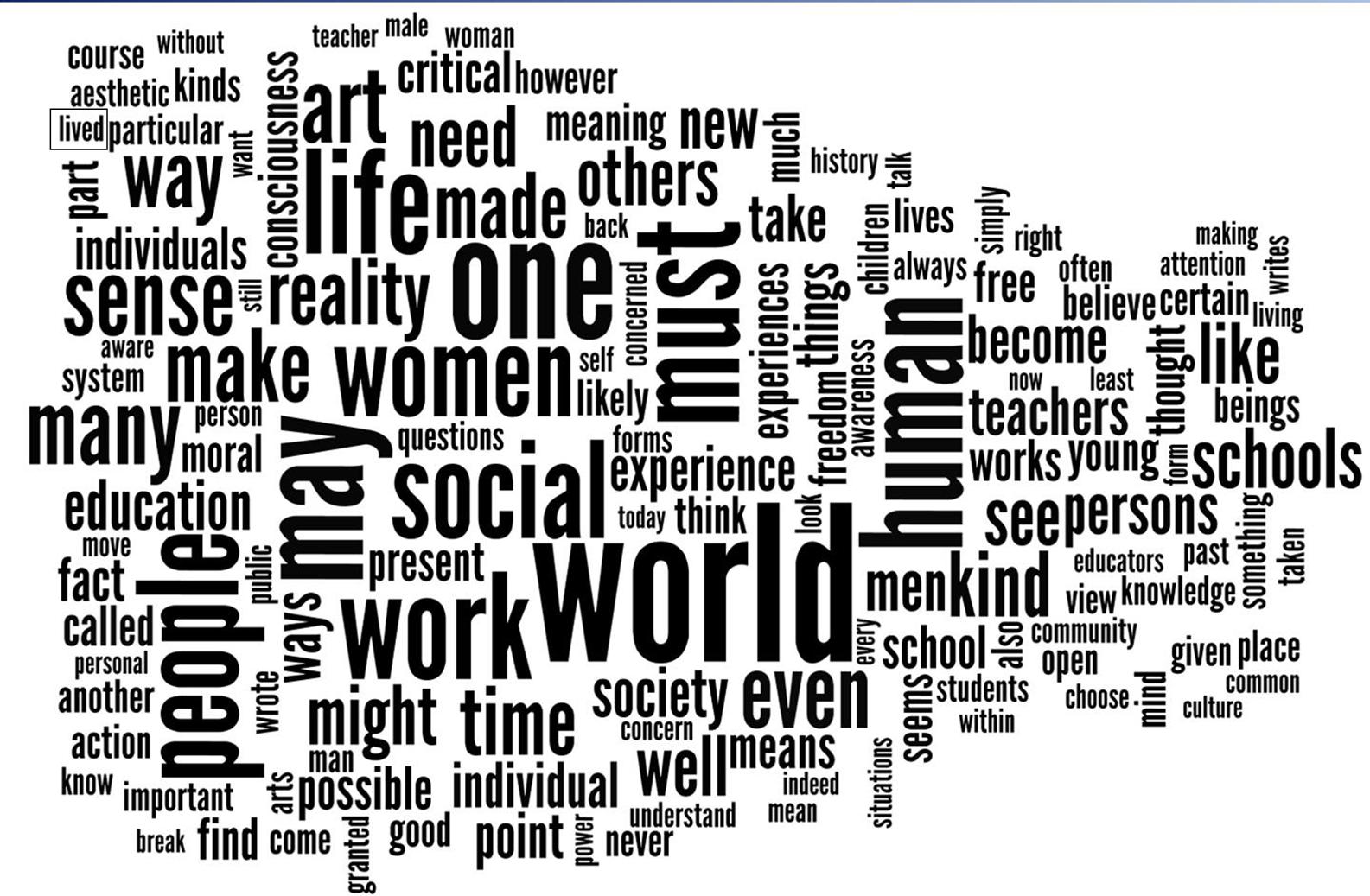
In contemplating how this dissertation that contemplates the use of "lived life" in Maxine Greene's writings could be visualized. I did some Wordle work with her texts.
I was interested in the visual because of my intention of using arts-based research in my work. I have thought of this dissertation as an exhibition of Greene's works, her art. And I felt it necessary to "see" the works in another medium.
But I love text. Yet, how can a textual-based exhibition be visual to the reader/attender? I go back to Barbara Kruger's work and Jenny Holzer's. Their pieces, so iconic for me of 1980s New York City, provide a kind of imprimatur of how text can be visual. What's more, the text itself can embody in an explicit way instead of a covert way, how images impact our own perspectives. I am reminded of this in reviewing Landscapes of Learning recently and thinking how Marshall McLuhan may have been a factor in Greene's discussion of Ellul's "encirclement". The idea that "people are experiencing themselves being worked on by forces as invisible as they are impersonal" (1978, p. 9).
And so I "Wordled" Greene's text. It's interesting to see the words that dominate. As I suspected, the "lived" in "lived life" is mostly prevalent in her later works (though it does reveal itself in Landscapes but not in the later Dialectic). Whether I use these images in my own textual copy is still unknown. But it was diversion, it provided another angle of repose in this crystallization of a reflexive practice.
Teacher As Stranger (1973)
Landscapes of Learning (1978)
The Dialectic of Freedom (1988)
Releasing the Imagination (1995)
Variations on a Blue Guitar (2001)
Showing posts with label text. Show all posts
Wednesday, August 17, 2011
Wednesday, December 22, 2010
Embodiment
I'm reading, reading, reading. Hoping that the reading, reading, reading is going to elicit a literature review. A literature review of what? I'm still not sure. I have written about using the review as an opportunity to investigate the writers who have impacted Maxine Greene as a means towards defining key concepts/words/ideas. I liked that idea but somehow it seemed overwhelming to me. Readers and students often respond to Greene as being extraordinarily well-read, extremely literate. And as readers and students we often feel incapable of matching such an well-read, literate mind.
Another idea is to review what others have written about Greene in an effort to get a glimpse from elsewhere as the origins and meanings behind my search of the "lived life" in Greene's works. Naturally, I am having difficulty finding anything that touches on the phrase either within Greene's canon and elsewhere in philosophy, literature, education.
But I did come across some essays that explore Merleau-Ponty's le corps vecu in Baldacchino's "Education Beyond Education." The lived body or "embodiment" was the existentialist reconciliation of the mind/body split. It promotes an active stance towards philosophy and knowledge and helps us to understand Greene's promotion of doing philosophy.
In thinking about this, I was reminded of my own corps vecu training in acting. Training at the Experimental Theatre Wing at NYU, I encountered a number of physical approaches to creating and doing theatre. Jerzy Grotowski was a god on the 2nd floor of 721 Broadway. Grotowski wrote:
Another idea is to review what others have written about Greene in an effort to get a glimpse from elsewhere as the origins and meanings behind my search of the "lived life" in Greene's works. Naturally, I am having difficulty finding anything that touches on the phrase either within Greene's canon and elsewhere in philosophy, literature, education.
But I did come across some essays that explore Merleau-Ponty's le corps vecu in Baldacchino's "Education Beyond Education." The lived body or "embodiment" was the existentialist reconciliation of the mind/body split. It promotes an active stance towards philosophy and knowledge and helps us to understand Greene's promotion of doing philosophy.
In thinking about this, I was reminded of my own corps vecu training in acting. Training at the Experimental Theatre Wing at NYU, I encountered a number of physical approaches to creating and doing theatre. Jerzy Grotowski was a god on the 2nd floor of 721 Broadway. Grotowski wrote:
"The rhythm of life in modern civilization is characterized by pace, tension, a feeling of doom, the wish to hide our personal motives and the assumption of a variety of roles and masks in life (different ones with our family, at work, amongst friends or in community life, etc.-). We like to be 'scientific', by which we mean discursive and cerebral, since this attitude is dictated by the course of civilization. But we also want to pay tribute to our biological selves, to what we might call physiological pleasures. We do not want to be restricted in this sphere. Therefore we play a double game of intellect and instinct, thought and emotion; we try to divide ourselves artificially into body and soul. When we try to liberate ourselves from it all we start to shout and stamp, we convulse to the rhythm of music. In our search for liberation we reach biological chaos. We suffer most from a lack of totality, throwing ourselves away, squandering ourselves."
There was a great deal of shouting and stamping in those ETW studios. As actors we were embodying the text, the action, the story. Nancy Lesko in "Feeling the Teacher" writes about her own embodiment of Greene's teachings as a result of her sabbatical sojourn to Teachers College in 1996. As a yoga devotee, Lesko felt a lightness in her step and a realignment of her body every Monday evening as she exited the lecture space in Main Hall to return to her student family housing in Morningside Heights.
The lived life versus the lived body? I'm sure where this may be taking me but le corps vecu is very attractive to me as an Odin Theatre/Grotowski trained/Bogart influenced actor.
The journey continues...
Sunday, August 15, 2010
Text is cool. Language is hot.
The scanning process continues. I try to be cool and objective, literally searching--without digital or electronic aid-- for the term "lived life." But then I get swept into the language. I try not to see the "language," but instead to search for text. Just words. A couple of "l's" strung together. It's a "Where's Waldo?" approach.
But Greene sweeps me in with her language. I end up reading and thinking and interpreting and bringing my particular sense, my live life, to the language.
This happened with Greene's chapter on "Approaches to Truth and Being" in "Teacher as Stranger." In her remarks about pragmatism, phenomenology, and existentialism,, I started to see Greene's foundation in her doing philosophy. I see her disposal of the role of pragmatism in its attempts to measure things, like humans, that cannot possibly be measure without some accounting of biography. While "lived life" isn't being used, I think I'm witnessing its development here in this 1973 publication.
Earlier this morning I reviewed a booklet on dissertations in the humanities. One of my committee members very thoughtfully sent it to me to help me with this framework. It's quite different form the empirical/science-based framework that is being promoted within the Ed.D. program. The booklet offers standards that use descriptors of outstanding, very good, acceptable and unacceptable.
Within one of the standards for outstanding, the qualities listed int he area of language included "hot." I like this. Language should be hot.
Text, on the other hand, is cool.
But Greene sweeps me in with her language. I end up reading and thinking and interpreting and bringing my particular sense, my live life, to the language.
This happened with Greene's chapter on "Approaches to Truth and Being" in "Teacher as Stranger." In her remarks about pragmatism, phenomenology, and existentialism,, I started to see Greene's foundation in her doing philosophy. I see her disposal of the role of pragmatism in its attempts to measure things, like humans, that cannot possibly be measure without some accounting of biography. While "lived life" isn't being used, I think I'm witnessing its development here in this 1973 publication.
Earlier this morning I reviewed a booklet on dissertations in the humanities. One of my committee members very thoughtfully sent it to me to help me with this framework. It's quite different form the empirical/science-based framework that is being promoted within the Ed.D. program. The booklet offers standards that use descriptors of outstanding, very good, acceptable and unacceptable.
Within one of the standards for outstanding, the qualities listed int he area of language included "hot." I like this. Language should be hot.
Text, on the other hand, is cool.
Subscribe to:
Posts (Atom)