Thursday, September 22, 2011

The action of art: Rosenberg & Greene

I have been reading Harold Rosenberg's "The American Action Painters" (1952). This essay manifests a moment that I take for granted. It's a moment distinguished by a uniquely American contemporary foray into modernism. I have found a couple of gems from this essay that speak to me:

"What was to go on the canvas was not a picture but an event."
Here Rosenberg might be providing an entry into the idea of the creative act. Notice that I use the word "act" here, a term/idea that is common in 2011 but may have its provenance with Rosenberg. (This startles me. Wow.) This brings to mind the active state that Greene and others ascribe to the doing of philosophy. It is dynamic, engaging, active, something fully realized.

"It is to be taken for granted that in the final effect, the image, whatever be or be not in it, will be a tension."
I'm drawn to this because of the use of tension. In my acting training at the Experimental Theatre Wing at New York City in the mid 1980s, I was mentored by wonderful teachers who applied a physical approach to acting. Many of them spoke of the wonder of tension and its usefulness to an actor. My prior training had been disparaging of tension. The training would focus on being relaxed so as to be open to what a scene partner may be imparting. But at ETW, they recognized the forcefulness, the theatricality, the heightened sensibility that tension afforded an actor. It is the filled stillness that I recounted in my dissertation  of Greene's Monday evening classes. Could this essay be where tension was finally lauded?

"A painting that is an act is inseparable from the biography of the artist."
Could this be the lived life?

Greene notes this essay in Teacher as Stranger (1973). The reference occurs within a chapter that highlights the new art forms of abstractions and happenings in the 1960s. Greene suggests that the spirit of these new art forms forced viewers to take on new perspectives of how they viewed art and the world around them and that the same spirit should be applied to education--students and teachers should also take on new perspectives.

But the essay also provides the gems that I found above as well as a lot of writing about consciousness and the conscious action that the new art had embodied. I can't help but to think that this essay was the tipping point of the break from the post-War/the man-in-the-grey-flannel-suit/Levittown sensibility that had been emblematic of the era.

It also sparks for me a sensation that I experienced in coming to understand these kinds of tipping points in the development of unique American art forms. It was years ago in Philadelphia at a booking conference for youth performances. The Lincoln center Institute had been invited to facilitate the conferences' professional development on the day prior to the conference. I was put in a group that was assigned to study Paul Taylor's "Aureole."

I had seen the dance performed a few months earlier at City Center's "Fall for Dance" series. My colleague and I weren't particularly taken by it. It seemed really balletic. Really traditional and usual and pastoral. We threw up our hands in a "meh" way on our walk down 6th Avenue after the performance. We were more excited by Les Grandes Ballets Canadiens as they had performed works by Ohad Naharin, whose unexpected jumps and cacophonies excited us.

But with the Lincoln Center Institute and my colleagues I cam to understand the significance of what "Aureole" was all about. What I passed off as balletic was actually ballet off-hinged. The dancers weren't traditionally turned out from the hips--their legs were perpendicular to the floor and their hips. The pastoral nature was pure movement of joy--not the tempered balletic sensibility of Tudor and others.

I came to understand that "Aureole" was a turning point in dance. What was "meh" in my uninformed viewing had been sensational in its debut. While I'm still not a fan of the dance, I truly admire what is happening within it.

These are tremendous moments. And these were occurring when Greene was, in my estimation, developing her philosophy, her voice.

Saturday, August 27, 2011

Depredations of technique

While waiting in doctors' offices and customer lounges at the local speedy lube joint, I have been perusing Stella Adler's Art of Acting. The book is broken down into the individual elements that comprise the Adler technique. The text is Adler herself documenting what she and her teachers say, talk about, opine, and rail against in their technique classes.

Reading it brings me back, instantly, to my undergraduate days at NYU where I was placed in the Stella Adler Conservatory. Admission into the undergraduate drama program was by application followed by an audition and interview. At the conclusion of my comedic and dramatic monologues, my adjudicator (the head of the Experimental Theatre Wing at the time) spoke at length at how schizophrenic I was in that I could forge a career in a variety of different directions: commercial, classical, musical theatre. He was adamant that I should be placed in the Circle in the Square training program, which was the most commercial of the acting conservatories that provided training to NYU students.

Imagine my surprise when my placement letter arrived in the mail and I found out that I would be going to the Stella Adler Conservatory.

The Adler technique could be described as falling into the category of "classical" training. Classes were geared towards a life in the theatre where the good writing could be found. While I never studied with Stella herself (her classes were reserved to third-year students and I transferred out in the middle of my second year), the language of Art as Acting is nearly verbatim of what I remember of my studies with her teachers Alice Winston, Mario Siletti and Jimmy Tripp.

I'm reading Adler right now as her adage, or how I remember the adage as repeated by her teachers, was "Hamlet was not written about your mother." The adage was in reference to the idea that an actor should never rely on their own emotional memory to create a character. Instead, a character should be created from the actor's imagination as guided by the circumstances provided by the playwright's words and ideas. And it was this adage that seemed to come into stark contrast with what I encountered ten years later and 60+ blocks further uptown in my studies with Maxine Greene (Adler's conservatory was located in Carnegie Hall while Greene's lecture hall was located in Morningside Heights).

While in my mind Greene emphasizes the importance of the lived life in developing understanding and fostering multiple perspectives, Adler was adamant about the importance of technique which ultimately, in my mind, distances an actor from their daily life. I do understand the focus on technique for a performing artist as it provides a grounding to return to performance after performance, city after city. It guarantees a similar quality of experience for the Wednesday matinee attendee as it does for the Saturday night viewer. This distance that technique demands from the actor's own emotional life as provides a bulwark against burning out.

But it's interesting to read Adler in association with my close readings of Greene. In Landscapes of Learning Greene writes about the "depredations of technique" in relation to positivism and objectivity in cognition. She writes:

It must become clear again that reflection is not only rooted in experience, its entire purpose is to inform and clarify experience—or the lived world. If we add to this a conceived possibility of remaining in touch with our perceptual backgrounds and thus remaining present to ourselves, we may be better able to ward off the depredations of technique (1978, p. 17).

These "depredations of technique" were recently touched upon by Antony Tommasini in his New York Times article "Virtuosos Becoming a Dime a Dozen." In the article Tommasini writes about the numerous musicians these days who possess impeccable technique that enable them to perform the most difficult of works. He likens it to sports where records are made to be broken. This represents a new paradigm in the classical music performance world where "the first several decades of the 20th century are considered a golden era by many piano buffs, a time when artistic imagination and musical richness were valued more than technical perfection." While Tommasini never denigrates technique, you can sense a yearning for imagination and richness.

This new paradigm of the virtuosic might be rendering this quality to becoming commonplace. There is an audience demand for it. What is the impact on the art form? What is the impact on the experience of the viewer of the art form? Does the virtuosic leave space for the viewer/listener to enter into the work of art, as emphasized by Greene? Is the virtuosic an example of the depredation of technique?

Sunday, August 21, 2011

Choice in lived life

This weekend has been devoted to some final notes on Maxine Greene's use of lived life in Variations on a Blue Guitar. The book is a series of lectures that Greene has given over the years at the Lincoln Center Institute where she is philosopher-in-residence. It is fitting that the writings/lectures are focused on aesthetics and teaching as the Institute is devoted to a particular kind of arts education developed under her guidance and the target population is K-12 teachers.
I think I may be finding a different sensibility regarding the lived life in these lectures/writing but more on that in a later post.

In reviewing this anthology, I was reminded this weekend of the tenet I held as an actor living and working in New York City in the 1980s and '90s. The tenet--or perhaps, justification--was the importance I placed in having a job outside of acting. It was necessary to be working in any capacity in order to pay the rent but it was also necessary to be working consistently in an institution so that I could get health insurance. I also held that it was important to work outside of acting in order to have experiences with the "real world" and with "real people" from which to draw inspiration for my acting. But then again, maybe it was just a ruse to excuse myself from not working harder at becoming a commercially successful actor.

No matter the reasons, I worked. And I worked for about eleven years as the supervisor of the TKTS booths in New York where you could buy a discounted ticket to a Broadway or off-Broadway show on the day of the performance.
It was spring of 1987. I was rehearsing a production of Strindberg's The Ghost Sonata, directed by Travis Preston (now of CalArts). It was a huge, wild production. I played the Fiancee, a mute part that was on stage for more than half of the play. The Fiancee is essentially waiting, for decades, for her betrothed to marry her. She is only seen and never heard.

With this, the physicality is paramount and I was working on developing a movement life for the Fiancee. Early one matinee Wednesday morning as I was readying Duffy Square for the matinee onslaught of Long Island/New Jersey/Connecticut/Upstate ladies who lunch, I couldn't help but to stare at a woman--who many years later I determined was trans--making her way down 7th Ave.
She was tall, gaunt, with a full face of makeup that looked like it was left over from the night before. She wore a lime-green polyester pant suit and high-heeled strappy sandals. She was smoking a cigarette in slow motion. She moved down the street without looking at where she was stepping. She was slightly unsteady, the look of a drunk trying not to look drunk. She was trying to avoid the piles of horse manure that littered the street (NYPD often used mounted police in that area) and was mostly successful but would occasionally catch the edge of a clump in her strappy sandals resulting in a near stumble.

It was the Fiancee. I had found my muse.

Though my body type was quite different from this lime-green vision, her walk and carriage became the body for the Fiancee. Her slow motion smoking became my focus of an act-long party scene that was seated around a six-foot slab of ice that slowly melted under the stage lights.

I come back to all of this because my assumption in thinking about the lived life within the aesthetic experience led me to conceive of my lime-green muse as part of my lived life as an actor. Those movements and people who serve as inspiration are the lived life I am exploring in Greene's work.
But after reviewing Variations, I'm shifting. I think it is the act of choosing I took in focusing on that woman making her way down 7th Ave. in spring 1987 that is the lived life. The lived life is how I go about making those choices, not the actual choice itself. What isn't clear to me, yet, is whether the recognition of those choices is considered part of the lived life or if lived life is the platform on which recognition and reflection can occur but only through follow-through; that reflection may not be a guaranteed element of lived life. In Variations, lived life is always presented as the "background" against which viewers/attenders/teachers/students can encounter a work of art. It is through these encounters with works of art that alternate realities can be considered and ultimately, lived lives can be transformed.

Lived life is certainly nuanced.

Wednesday, August 17, 2011

Textual imagery

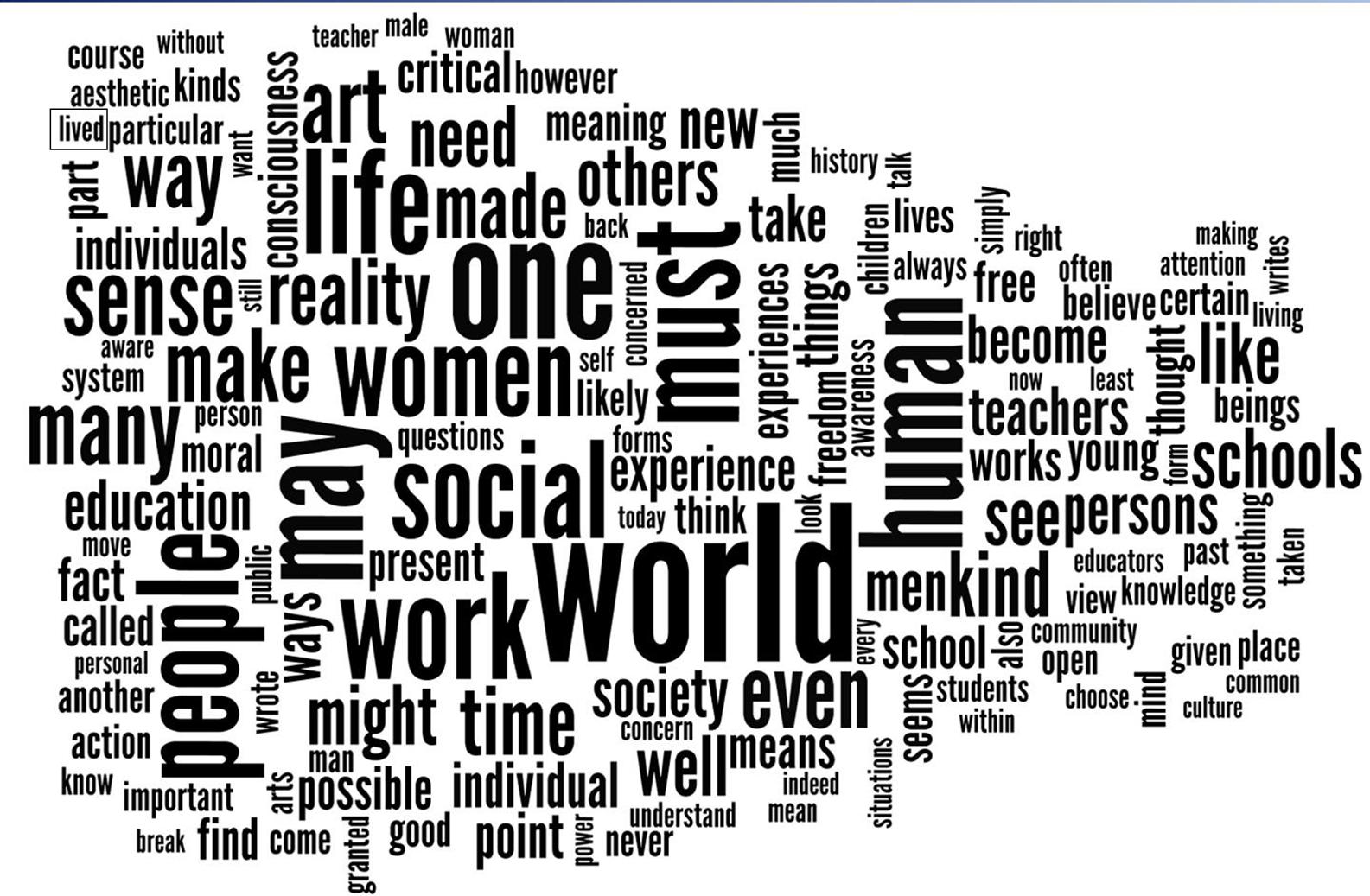
In contemplating how this dissertation that contemplates the use of "lived life" in Maxine Greene's writings could be visualized. I did some Wordle work with her texts.

I was interested in the visual because of my intention of using arts-based research in my work. I have thought of this dissertation as an exhibition of Greene's works, her art. And I felt it necessary to "see" the works in another medium.

But I love text. Yet, how can a textual-based exhibition be visual to the reader/attender? I go back to Barbara Kruger's work and Jenny Holzer's. Their pieces, so iconic for me of 1980s New York City, provide a kind of imprimatur of how text can be visual. What's more, the text itself can embody in an explicit way instead of a covert way, how images impact our own perspectives. I am reminded of this in reviewing Landscapes of Learning recently and thinking how Marshall McLuhan may have been a factor in Greene's discussion of Ellul's "encirclement". The idea that "people are experiencing themselves being worked on by forces as invisible as they are impersonal" (1978, p. 9).

And so I "Wordled" Greene's text. It's interesting to see the words that dominate. As I suspected, the "lived" in "lived life" is mostly prevalent in her later works (though it does reveal itself in Landscapes but not in the later Dialectic). Whether I use these images in my own textual copy is still unknown. But it was diversion, it provided another angle of repose in this crystallization of a reflexive practice.


Teacher As Stranger (1973)


Landscapes of Learning (1978)

 The Dialectic of Freedom (1988)


Releasing the Imagination (1995)


Variations on a Blue Guitar (2001)

Saturday, August 6, 2011

From transaction to transformation


One of my committee members recently commented on my embodiment post. In my response I started to focus on the idea of transaction. The focus arose out of a desire to promote and enhance the concept of the quality of transaction in Greene's writing. It occurred to me that the way in which we interact with the world deepens this sense of embodiment and differentiates Greene from other thinkers and writers who have commented on embodiment.

I noted that embodiment is about the constant reflection of how we view ourselves within the context of our perceived world. It is my sensibility that we are witness to transactions with the world that continue to operate within the realm of a mind/body split. I am thinking in terms of educational practice and in how we define success. We continue to assess the success of our students (and our practice) through a predominately retention/regurgitation framework. And though I'm critiquing policy with this example, policy is a means of how we transact with the world. 

Of course, this can all be viewed as a transactional dilemma: our misguided practices are fundamentally poorly conceived transactions with the world. However, does how we transact connect directly to something more profound than mere practice options? Is this why we struggle with social justice? Is this why social justice isn't just the soil (per Dewey's discussion of embodiment in Nature and Experience) but points to a more profound split? How do the bottom-line-must-dominate CEOs and the just-say-no legislative representatives and their practices sleep at night? I conceive of these practices as poor transactions. I conceive of these transactions as a fundamental split between mind and body. With that split, the transactional can never become transformational.

With Greene, I can start to chart a process by which the transactional becomes transformational. In transacting with the world, we become situated in our understandings, our processes, our angle of repose. Through reflection this situatedness becomes embodied. Our understanding signifies that union of mind and body, even relinking what once may have been split. This is what represents the lived life: the embodied situatedness of our being. It is the lived life that primes us to encounter the world through an aesthetic experience. The aesthetic represents the embodied encounter, an encounter that has the ability to be transformative because of the reflective practice that enables us to notice the new. It is the act of writing and rewriting our lived world (Releasing the Imagination, 1995, p. 147).

Sunday, July 24, 2011

The sediment of embodiment

In using this blog I have come to realize that there are stirrings and strains within my thinking that keep on re-emerging time and time again. When I review past postings, I see my hunches and notions playing out at different periods during this process, often without memory of their previous existence. For instance, claiming the use of my first-person voice as a creative act. When I wrote about that notion within my methodology chapter, I hadn't realized I had considered it months earlier in Living [Maxine] Greene.

This past week I discovered that my interest in embodiment as a function of learning, as a function of coming to know, as a function of consciousness, has been stirring within for some time. During the week I was teaching a one-week intensive in arts education for masters-level students. One of our sessions included a visit from a teaching artist who presented work she had done in a residency at a school of one of my former students.

The impetus for the residency arose out of my student's frustration as a math interventionist. The interventions she was assigned to use consisted of worksheets: paper and pencil.  But the students she was assisting did not excel in paper and pencil approaches. We tossed around ideas about arts integration strategies that she might attempt in the seated-at-desks setting that she and her students occupied. But what became apparent was the kinesthetic tendencies these students had towards their learning. "Get thee to a movement specialist," I advised her, "and let the embodiment of math begin!"

The residency came together and the movement specialist took my recent class through some of the work she did with the students. But the discussions and ruminations I had with the math interventionist occurred long before my literature review where embodiment presented itself to me as a foundation for coming to know the lived life. Clearly, embodiment was been part of the "sediment" I bring to my inquiry. This sediment is not fixed according to Greene:
And we need, as Maurice Merleau-Ponty has put it, to form the events we uncover in the past into an "intelligible series," the events that sediment meanings in us, "not just as survivals or residues, but as the invitation to a series, the necessity of a future" (LL, 1978, p. 119).
Sediment indicates a layering and accumulation of meaning which allows for change over time. The fossils infused in the first strata, while foundational in character, don't prescribe a sameness within the subsequent accumulating layers.

In writing this post I am also connecting back to my own training as an artist which, at one point, was rigorously physical in its approach. My work with Anne Bogart, Kevin Kuhlke, Nina Martin, Wendall Beavers, Mary Overlie, Paul Langland, Torben Bjelke, Maria Consagra and others focused on the idea of physical improvisation to find and sustain character development. Though I did note this in my dissertation, somewhere, I tend to forget this most obvious element in my focus on embodiment. It's what a former roommate would call a "no duh" moment (he's now a full professor of philosophy in the Midwest so I embrace his neologisms with hope).

And so this sediment of embodiment is present within me. It is foundational in how I have come to engage in the arts and in the world. It aligns with the sense of accumulation, where meaning and interpretation can change over time. It is most certainly Merleau-Ponty's "invitation to a series, the necessity of a future" (Themes from the Lectures at the College de France 1952-1960, Evanston: Northwestern University Press, 1970, pp. 40-41). It is also the basis of the aesthetic experience of learning. These connections give me pause, compel me to reflect, find me forgetting to breathe and often on the edge of my seat.

Sunday, July 10, 2011

Greene-asserted and Greene-realized

My scanning thus far has actually only accounted for maybe a dozen, at most, instances of lived life/lives in Maxine Greene's writings. One of my earliest hunches in this inquiry was that the term only begins to become part of the Greene vernacular in her later writings. So far, this hunch is playing itself out.

I'm conceiving a series of turning points that each book seems to represent. My focus on Teacher as Stranger (1973), Landscapes of Learning (1978), The Dialectic of Freedom (1988), Releasing the Imagination (1995), and Variations on a Blue Guitar (2001) for this inquiry was borne out of an early notion that these books represent Greene's own voice. Her earlier works, Existential Encounters for Teachers (1965) and The Public School and the Private Vision (1968), struck me as primarily commentaries on other thinkers and writers. While Greene continues to cite and reference other writers and artists in the canon that starts in 1973, her own voice is pronounced in these later works. Perhaps one could perceive of this voice as a recitative; in effect, forwarding the ideas of these other writers and thinkers in a solo voice.
But the voice becomes stronger with subsequent works. Teacher as Stranger and Landscapes of Learning may indeed be a recitative of the works of Camus, Dewey, Kant, Kierkegaard, Melville, Merleau-Ponty, Sartre and others. But in her final section of Landscapes titled "Predicaments of Women," I sense a turning point in this coda to the book. Her chapter "Lived Worlds" is focused on the need for women to assert their own interpreted reality in a world that is largely reliant on a male perspective of reality.
My concern is for the release of individual capacities now suppressed, for the development of free and autonomous personalities. It seems to me that these require an intensified critical awareness of our relation to ourselves and to our culture, a clarified sense of our own realities (1978, p. 213).
It is a call to self-hood. As I conjectured in my 7/9 post, this "clarified sense of our own realities" is consciousness. This is a call to consciousness. The lived aspect of the lived world is consciousness. This final section of Landscapes represents, to me, a thrusting outward of Greene's push for social justice. It is Greene-assertive. It is the opening thrust of her voice.

Later, in Dialectic, the recitative is pianissimo. Greene comes back to the predicaments of women, calling  upon the unique, social, intertwined and situated realities of women as a just and valid point of view and source of knowledge:
A free act, after all, is a particularized one. It is undertaken from the standpoint of a particular, situated person trying to bring into existence something contingent on his/her hopes, expectations, and capacities. The world in which the person creates and works through a future project cannot but be a social world; and the nature of the project cannot but be affected by shared meanings and interpretations of existing social realities. John Dewey wrote, for example, that "while singular beings in their singularity think, want, and decide, what they think and strive for, the content of their beliefs and intentions is a subject matter provided by association” (1927/1954, p. 25).  If that association is conceived of as one among autonomous, rational beings who are convinced that reliable knowledge (being largely formal and rule-governed) does not vary among them, the very notion of singularity summons up a troubling relativism that makes suspect situated knowledge claims. This may partly explain, not only the lack of respect for women's thought processes on the part of men, but the efforts of certain women to suppress their own lived experiences in order to claim an equality in the domain of formal reason identified with the public sphere.
Dialectic represents a turning point, for me, of Greene-realized. My interpretation is finding the use of the qualifier lived in Greene's writing to be in direct correlation to an assertion of a distinct, political voice. In Markie Hancock's documentary, Exclusions and Awakenings (2001), Greene talks about the perils of of a Jewish woman finding a teaching job in higher education. She was told she was "too literary" which for her was code for "female." In Dialectic she writes about the struggle she experienced in how she pursued understanding:
From the beginning of my career, trying with some difficulty to be accepted as a philosopher of education, I found myself moving back and forth between imaginative literature and philosophy. Troubled by the kinds of positivism that identified existential questions (about birth and death and commitment and anxiety and freedom) with "pseudo-questions," with a domain of meaninglessness, I kept on stubbornly seeking out those questions in fictive and poetic worlds, in personal narratives. Troubled by impersonality, by abstract vantage points, I wanted people to name themselves and tell their stories when they made their statements. I came to believe (or I was taught) that "reality" referred, after all, to interpreted experience (1988, pp. xi-xii). 
 There might be a linkage between this practice of interpreted experience and the particularization/situatedness of women. It might be that the qualifier of lived is particular to the female experience. I'm not ready to affirm this as Dewey's influence in his accounting for experience is reflected in Greene's reading and writing. Yet experience, for Greene, takes into account the gaps/lacks/deficiencies that can only be recognized through reflection. The reflected life isn't always optimistic, and neither is Greene (Hancock, 2001). Wendy Kohli and others see this as a distinction between Greene and Dewey (Hancock, 2001). Greene's pessimism is situated to her own lived life as a woman in a man's world.